
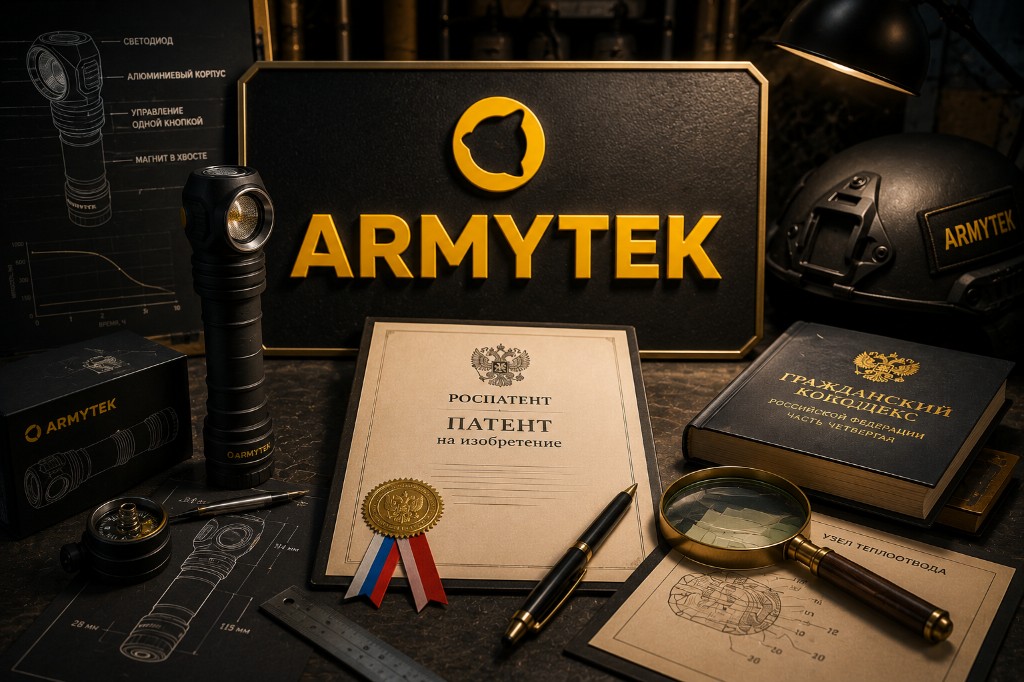
Key Takeaways
- The Rospatent Chamber found the initial refusal to register trademark application No. 2024748789 unjustified and reversed the earlier decision, allowing registration of the mark in full for the claimed goods in Classes 09 and 11 of the Nice Classification.
- Despite establishing phonetic similarity between the applied-for designation "ARMYTEK" and earlier registered designations under Certificates Nos. 364041 and 733832, the obstacle under Article 1483(6) of the Russian Civil Code was held to have been overcome due to the absence of similarity of goods.
- A material factor in revising Rospatent's position was the effective decision of the Intellectual Property Rights Court in case No. SIP-629/2025 on the early termination of legal protection of the cited trademarks in respect of part of the goods in Classes 09 and 11 of the Nice Classification.
- When assessing similarity of goods, the functional-economic criterion was applied: product purpose, consumer circles, distribution channels, interchangeability, and the likelihood of an association with a single manufacturer were analyzed.
- The Chamber affirmed the independent significance of the similarity-of-goods criterion: even where signs are similar, the absence of a likelihood of confusion with respect to specific goods precludes the application of the prohibition under Article 1483(6)(2) of the Russian Civil Code.
Legal Analysis
Subject matter and legal framework
The present opinion is of practical interest in defining the limits of application of Article 1483(6)(2) of the Russian Civil Code in situations where formal similarity of designations is not accompanied by similarity of goods.
The subject of the administrative dispute was Rospatent's decision to refuse legal protection to the designation under application No. 2024748789 in respect of certain goods in Classes 09 and 11 of the Nice Classification. The refusal was based on the examiner's conclusion that there was similarity to the point of confusion with earlier registered trademarks having earlier priority.
In examining the opposition, the Chamber applied the provisions of Part Four of the Russian Civil Code, as well as the Rules for the Drafting, Filing, and Examination of Documents Serving as a Basis for Performing Legally Significant Actions for the State Registration of Trademarks.
The legal framework of the dispute was structured around the cumulative application of two criteria: the degree of similarity of the designations and the similarity of goods. The Chamber consistently reiterated the approach according to which the prohibition on registration arises not from the mere fact of similarity of designations, but exclusively where there is a likelihood of confusion with respect to similar goods.
Similarity of designations
During the analysis, it was established that the applied-for designation constitutes the verbal element "ARMYTEK" in Latin characters. The citations were earlier registered designations containing the elements "АРМТЕК" and "ARMTEK."
The assessment of similarity was carried out in accordance with the criteria set forth in paragraphs 41–45 of the Rules. The Chamber concluded that there was pronounced phonetic similarity of the designations due to the coincidence of the sequence of consonants and vowels, as well as the overall perception of the designations as fanciful verbal constructs. Graphic differences were deemed secondary, while semantic analysis was held to be of limited applicability due to the absence of independent lexical content in the disputed designations.
However, the finding of similarity did not automatically result in a refusal of registration.
Scope of cited rights and similarity of goods
Of decisive importance were circumstances relating to the modification of the scope of exclusive rights in the cited trademarks. The case file reflected that the Intellectual Property Rights Court, in case No. SIP-629/2025, had previously early terminated the legal protection of the respective registrations in respect of a number of goods in Classes 09 and 11 of the Nice Classification. This information was entered into the State Register of Trademarks and duly published.
Following the adjustment of the scope of legal protection, the Chamber conducted a re-evaluation of the similarity of goods.
With respect to goods in Class 09, it was determined that there was no overlap in generic categories: the applicant's goods pertained primarily to the segment of power supplies, charging devices, and lighting devices, whereas the cited goods covered industrial electrical equipment, welding apparatus, and diagnostic devices. Differences were noted in functional purpose, economic circulation, consumer composition, and the absence of interchangeability.
A similar approach was applied to goods in Class 11 of the Nice Classification. Lighting equipment, lamps, and lighting products were held to be dissimilar to heating, ventilation, anti-icing, and climate control systems for vehicles and premises.
The Chamber thereby effectively confirmed the established approach in enforcement practice: likelihood of confusion is a derivative concept, and a conclusion on its existence cannot be based solely on formal similarity of designations without an examination of the actual product market and the nature of use of the means of individualization in question.
As a result of the examination of the opposition, the opposition was granted, and Rospatent's decision was reversed, with legal protection being granted to the applied-for designation in respect of the full list of claimed goods.
Commentary by Patent Attorney A.V. Leonov
The position under review confirms one of the most significant practical trends of recent years: the existence of a similar trademark in the register does not in itself preclude the registration of a new designation.
For rights holders, this case highlights the risk of overly broad goods coverage without actual use of the mark. Where a registration is formally maintained but not supported by the actual introduction of goods into civil circulation, there is a risk of partial early termination of legal protection and the consequent loss of the ability to block registration of similar designations.
For applicants, the decision demonstrates the effectiveness of a comprehensive defense strategy. In this case, use was made not only of the argument that the goods were not similar, but also of the preliminary removal of the obstacle through the procedure for terminating legal protection in respect of unused items. In practice, it is precisely this sequence of actions that often determines the final outcome.
Recommendations for rights holders and applicants
- Conduct regular audits of registered trademarks: verify the relevance of the Nice Classification lists, confirm use for key categories of goods, and timely update the evidentiary record;
- Document the supply chain, distributor relationships, and the brand's commercial presence;
- When facing a preliminary refusal under Article 1483(6), analyze not only the similarity of the designations, but also the actual scope of the opponent's exclusive rights: the existence of use, the preservation of protection in individual classes, the actual structure of the product market, and the degree of commercial proximity between the goods.
The prospects for similar disputes are assessed as consistently favorable for applicants when two factors are present simultaneously: documented non-similarity of goods and the ability to reduce the scope of the cited rights through the mechanism of early termination of protection. At the same time, an attempt to construct a defense solely on the argument of long-term use of the designation, without engaging with the criteria of similarity of goods, generally does not achieve the required procedural outcome.
Related Materials
Further IPPRO analysis on goods similarity, likelihood of confusion, and Rospatent Board practice: