
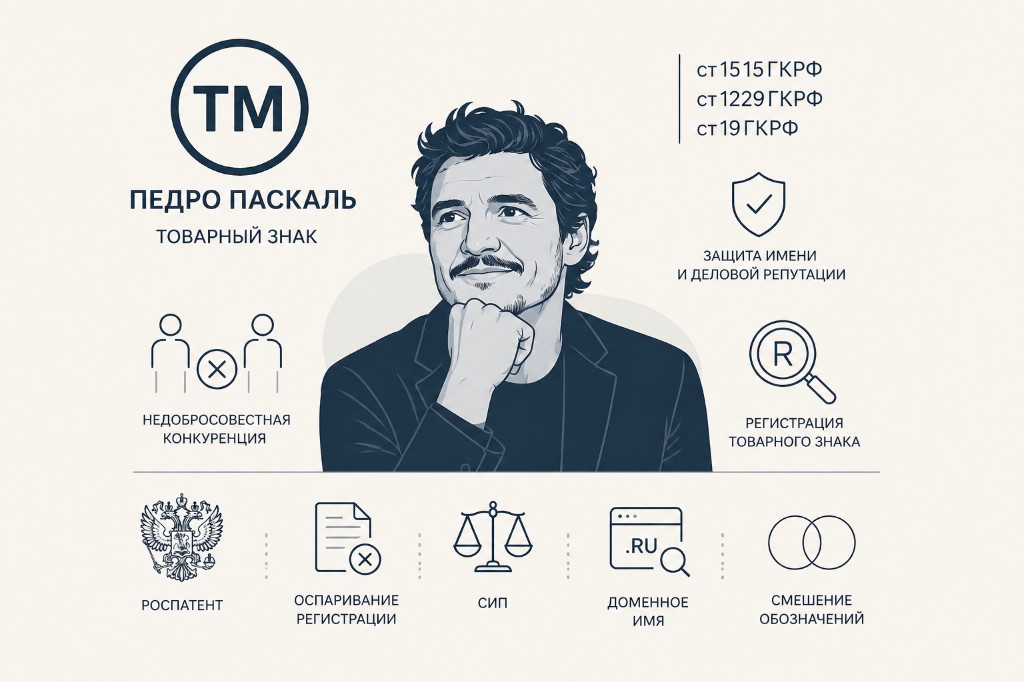
Block 1. Key Theses
- The registration of a trademark phonetically and visually similar to the name of a well-known natural person may be qualified as unfair appropriation of reputation (free-riding on fame) where there are indications of intentional commercial exploitation of another person's renown.
- The good faith of acquiring exclusive rights to a means of individualization is presumed in the absence of timely filed oppositions by third parties within the administrative registration procedure; however, this presumption is rebuttable in court.
- The assessment of the similarity between a designation and a personal name shall be made in conjunction with the context of its use: the absence of visual associations with a specific person on the label, the specific characteristics of the relevant class of goods, and the documented history of the creation of the designation.
- Pre-trial protective measures, including challenging domain names containing the disputed element, may be employed by the right holder concurrently with court proceedings on the merits of the invalidation of the trademark registration.
Block 2. Legal Analysis
Actor Pedro Pascal is suing entrepreneur David Herrera in Chile. In 2023, Herrera registered a trademark for pisco, a traditional Chilean alcoholic beverage, under the name "Pedro Piscal."
In the context of the present dispute, arising within the jurisdiction of the Republic of Chile yet having material significance for law enforcement practice in the field of protection of means of individualization in the Russian Federation, the conflict between exclusive rights to a trademark and the non-property rights of a natural person to their name must be analyzed.
Name rights and similarity standard in Russian legal doctrine
Under Article 19 of the Civil Code of the Russian Federation, a citizen acquires and exercises rights and obligations under their own name, comprising a surname and given name, and, in cases provided for by law, under a pseudonym. The use of the name of a well-known person as an element of a trademark without their consent, provided such use is capable of misleading consumers as to a connection between the goods and that person, may be qualified as a violation of Article 1229 of the Civil Code of the Russian Federation, which establishes the inadmissibility of using an intellectual activity result or a means of individualization without the consent of the right holder.
Judicial practice of the Intellectual Property Court of the Russian Federation proceeds from the principle that the criterion for protecting a name as an object of civil rights in the context of combating unfair competition is not only identity but also the degree of similarity of the designations, assessed from the perspective of the average consumer of the relevant goods (Ruling of the Intellectual Property Court No. С01-876/2021 dated September 24, 2021). In this regard, the presence of additional elements in the designation (in the case at hand, "Piscal" versus "Pascal") does not preclude a finding of likelihood of confusion if the dominant element is recognized as a name possessing independent renown.
Good faith presumption and burden of proof
At the same time, under Article 1483 of the Civil Code of the Russian Federation, the registration of designations capable of misleading consumers as to the goods or their manufacturer is not permitted. However, the burden of proving bad faith in the registration rests on the party challenging the legal protection. In the absence of direct evidence of intent to free-ride (e.g., use of the actor's image, direct references in advertising), and when there is a documented independent history of creation of the designation (e.g., a family gathering, etymological link to a grape variety or traditional beverage), the court may conclude that the elements of infringement are absent.
Territorial scope and cross-border protection strategy
The procedural aspect of the dispute is complicated by the territorial nature of exclusive rights: registration of a trademark in Chile does not confer legal protection within the territory of the Russian Federation. However, actions to "displace" the brand from domain zones containing the name "Pedro" demonstrate that the right holder is employing cross-border protection strategies, which aligns with trends in the development of practice in the field of cybersquatting and unfair use of domain names (Article 14.2 of the Federal Law "On Protection of Competition").
Consequently, the legal qualification of such disputes requires a comprehensive assessment of: (1) the degree of renown of the name in the relevant territory; (2) the nature of the use of the designation in commercial circulation; (3) the presence or absence of good-faith grounds for the selection and registration of the disputed designation; and (4) the actual consequences of use, including likelihood of confusion and reputational damage.
Block 3. Commentary by A.V. Leonov, Patent Attorney
In practice, disputes involving the use of the name of a well-known person in a trademark are high-risk for both right holders and applicants. We draw clients' attention to the following aspects.
For right holders (well-known persons)
- We recommend conducting proactive monitoring of trademark registers (including WIPO international databases) across key Nice Classification classes related to your professional activity and related fields.
- Upon discovering the registration of a similar-sounding designation, it is advisable to file oppositions with the patent office (in the Russian Federation, Rospatent) as part of the administrative procedure as swiftly as possible, as missing the deadline significantly reduces the chances of successful challenge.
- Pre-trial settlement, including sending cease-and-desist letters and working with domain name registrars (as in the case of displacing "pedro" domains), allows for prompt minimization of reputational damage and the creation of a favorable evidentiary record for subsequent court proceedings.
For trademark applicants
- When selecting a designation containing common names, it is necessary to document the creative process and etymological justification (as in Herrera's position: the link with the Pedro Ximenez grape variety and the "piscola" cocktail). This will serve to rebut the presumption of bad faith during challenge proceedings.
- Avoid using visual elements capable of reinforcing an association with a specific well-known person (photographs, silhouettes, characteristic attributes), even if the verbal part of the designation has an independent origin.
- Bear in mind that successful trademark registration does not guarantee its stability: invalidation is possible throughout the entire term of legal protection should new evidence of bad faith emerge.
Prospects for disputes: In Russian practice, the likelihood of a claim for trademark cancellation on the grounds of violation of name rights increases where there is: (1) proven wide renown of the name in the territory of the Russian Federation; (2) use of the mark on goods/services targeting the same audience as the well-known person's activities; (3) circumstantial evidence of intent (timely registration following a peak in popularity, imitation of style). However, where a convincing independent justification for the selection of the designation exists, courts tend to maintain legal protection, guided by the principle of stability of civil transactions.
Related Materials
Further IPPRO analysis on unfair competition, trademark invalidation, and cross-border protection strategy: