
Key Takeaways
- Elimination of grounds for refusal through image substitution: The Patent Dispute Chamber (PDC) held that excluding the verbal element “TOP SECURITY” from industrial design images during opposition proceedings is permissible, finding that such correction does not alter the essence of the claimed article’s appearance.
- Priority of trademark rights over industrial design: The initial refusal by Rospatent was justified by the existence of a previously registered trademark owned by a third party (Zhejiang Zhongming Lock Co., Ltd.) identical to the lock design element, which created a risk of misleading consumers under subparagraph 2 of paragraph 5 of Article 1352 of the Civil Code of the Russian Federation (CC RF).
- Distinction between essential and non-essential features: The PDC qualified the verbal designation as a non-essential feature, the exclusion of which does not affect the overall visual impression of the industrial design, thereby allowing the priority date of the international application (August 20, 2025) to be preserved.
- Restoration of legal protection: Rospatent’s decision to refuse legal protection was overturned, and international registration No. DM/249338 was recognized as valid on the territory of the Russian Federation to the extent of the amended images that no longer contain the conflicting designation.
Legal Analysis
Subject of analysis: Determination of the legality and validity of the decision of the Federal Service for Intellectual Property (Rospatent) to refuse legal protection to an industrial design, as well as the propriety of granting the applicant’s opposition in light of the submission of replacement image sheets.
Case facts and procedural context
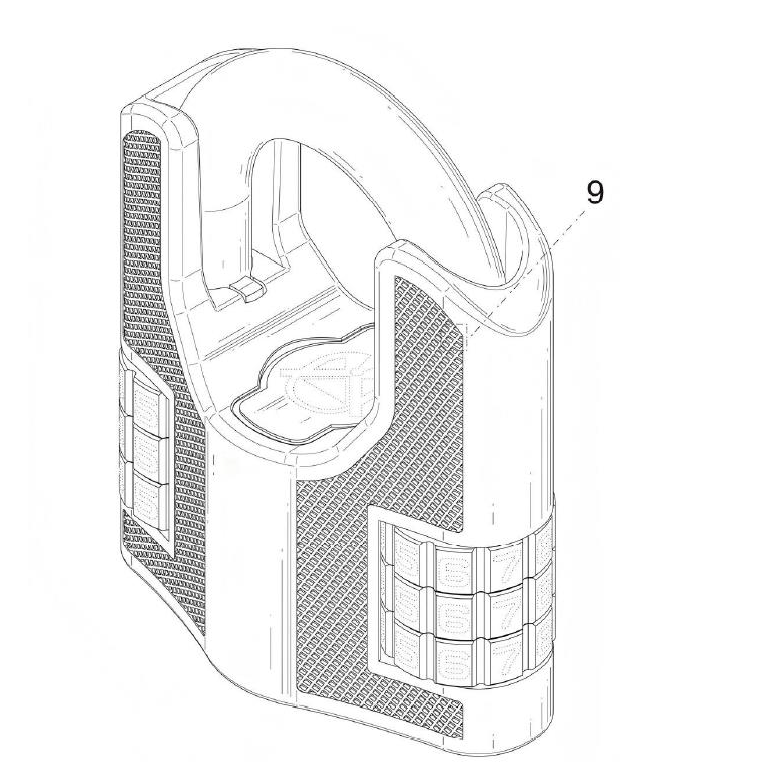
A foreign entity — Jinhua Xinlei Lock Industry Co., Ltd. (China) — filed an opposition against Rospatent’s decision of January 28, 2026, refusing to recognize the effect of international industrial design registration No. DM/249338 (“Combination Lock”) on the territory of the Russian Federation. The refusal was justified by the non-compliance of the claimed subject matter with the requirements of subparagraph 2 of paragraph 5 of Article 1352 of the Civil Code of the Russian Federation (hereinafter, the CC RF).
Rospatent found that the compositional solution of the industrial design (images 1.1–1.3 and 1.8) contained the verbal designation “TOP SECURITY,” which produces the same overall impression as a trademark owned by another person (Russian Federation Certificate No. 1076234, priority dated April 12, 2024). Since the rights to said means of individualization arose prior to the priority date of the industrial design (August 20, 2025), the office concluded that there was a risk of misleading consumers as to the manufacturer of the article.
Legal qualification of the applicant’s actions and the Board’s position
In the course of the opposition proceedings, the applicant submitted amended images from which the disputed verbal designation “TOP SECURITY” had been excluded. The key question for the Board was whether such amendments entailed a change in the essence of the claimed industrial design.
Under paragraph 72 of the Rules for the Preparation, Filing, and Examination of Documents Serving as a Basis for Legally Significant Actions for the State Registration of Industrial Designs (approved by Order No. 695 of the Ministry of Economic Development of the Russian Federation dated September 30, 2015), non-essential features include barely discernible and inexpressive elements, the exclusion of which does not lead to a change in the overall visual impression. The Board, relying on this provision as well as on the opinion of the specialized expert division, concluded that the verbal element is not a dominant feature determining the aesthetic characteristic of the article. Consequently, its exclusion does not alter the essence of the intellectual property object.
Application of international and national law
The provisions of the Geneva Act of 1999 of the Hague Agreement Concerning the International Registration of Industrial Designs (ratified by Federal Law No. 55-FZ of April 3, 2017) were applied in examining the case. Under Article 12 of the Act, the office of a Contracting Party is entitled to refuse protection where the conditions of national legislation are not met. However, such refusal must be reasoned and may be overcome if the applicant eliminates the identified deficiencies without affecting the identity of the object itself.
The Board determined that after the exclusion of the conflicting element, the industrial design meets the criteria of novelty and originality (paragraphs 2 and 3 of Article 1352 of the CC RF) and also does not infringe the rights of third parties to means of individualization (paragraph 6 of Article 1483 of the CC RF). The information search conducted by Rospatent revealed no other obstacles to registration.
Holding
Based on the foregoing, the Board granted the opposition, overturned Rospatent’s decision of January 28, 2026, and ordered that legal protection be granted to the industrial design under international registration No. DM/249338 on the territory of the Russian Federation to the extent of the amended images. This precedent confirms the possibility of “clearing” a design of conflicting elements at the administrative appeal stage without loss of priority date, provided that the creative concept of the article’s appearance is preserved.
Commentary by A.V. Leonov, Patent Attorney
Topic: Strategy for the “surgical” removal of conflicting elements in industrial design registration
The case under consideration is of significant practical interest for companies operating in international markets and utilizing the mechanism of the Hague Registration System. The situation where a product design includes decorative inscriptions or logos that may conflict with third-party trademarks registered earlier is typical. Such elements are often applied to the product for marketing purposes, but their inclusion within the scope of legal protection of an industrial design creates serious risks.
Key takeaways for business
- Permissibility of amendment at the opposition stage. Many applicants mistakenly believe that any change to images after filing is impossible or leads to a change in the priority date. The Board’s position clearly demonstrates: if the excluded element is not essential (i.e., does not form the main visual impression), the substitution of images is permissible. This allows the application to be saved from final refusal.
- Risk of including third-party trademarks in a design. The presence of the inscription “TOP SECURITY” on the lock body was the sole reason for refusal. The actual shape of the lock raised no objections. This underscores the importance of prior “clearing” of the design: before filing an application, all textual and graphic elements should be checked for conflict with trademark registers.
- Resource savings. Filing a new application with a modified design would have resulted in the loss of the priority date (August 20, 2025), which could have been fatal if similar designs had been published between the initial filing and the new application. Using the opposition mechanism allowed the early priority date to be preserved.
Recommendations for clients
- Design audit before filing: Before depositing or filing an industrial design application, screen all visible design elements (inscriptions, logos, unique patterns) for conflict with competitors’ existing trademarks (especially in the Nice Classification classes relevant to your product).
- Separation of protection: If a unique design contains a company logo, assess whether it would be preferable to register the logo separately as a trademark, while registering the industrial design in a “clean” form, free of textual elements. This broadens protection: the industrial design will protect the shape regardless of the brand applied to the product.
- Readiness to oppose: Upon receiving a preliminary refusal or a decision of refusal, analyze the possibility of excluding the disputed element. If it is of a decorative rather than structural nature, filing an opposition with replacement images is a highly effective defense tool.
The prospects for such disputes are favorable for applicants who are willing to adopt a flexible approach to shaping the scope of legal protection. The key is to demonstrate that the “severed” part was not the conceptual center of the design.
Related Materials
Further IPPRO analysis on industrial designs, Rospatent opposition, and the Hague System: